

What is DCS?
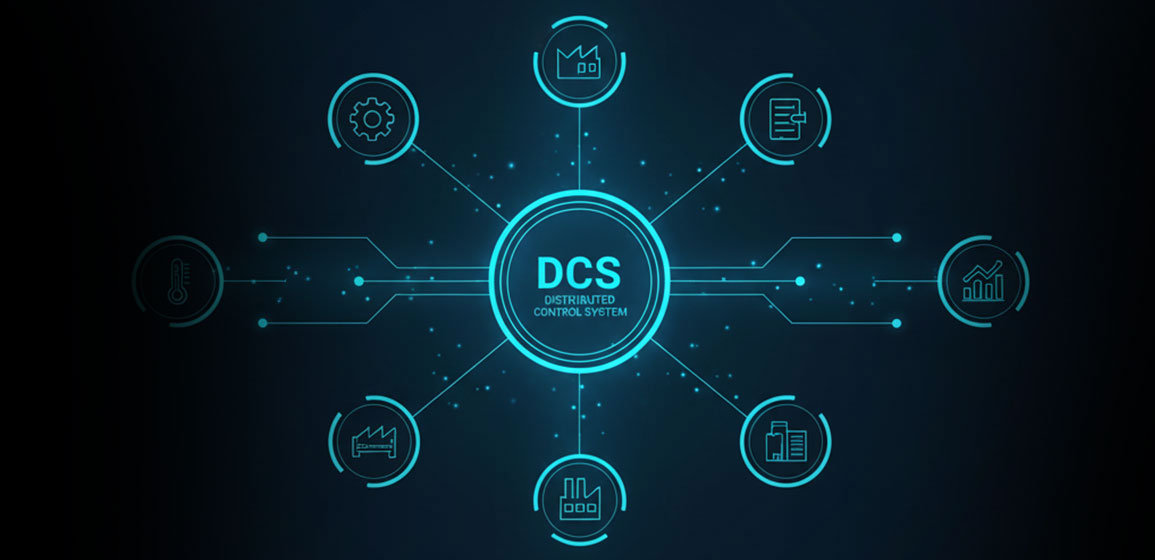
A Distributed Control System (DCS) can be defined as a control system architecture that distributes control functions across multiple local controllers while providing centralized monitoring and engineering. In simpler terms, it is a network of interconnected controllers, sensors, actuators, and operator interfaces that collectively manage industrial processes. Each local controller operates independently, executing its assigned control loops, but all controllers work together through a process control network, ensuring coordinated and optimized plant operation.
DCS is primarily used for continuous and batch processes requiring tight feedback control, such as chemical reactions, thermal energy management in power plants, or multi-step batch processing in food and pharmaceutical industries. It ensures high reliability, real-time monitoring, and the ability to handle complex interdependencies among various process variables.
Where DCS Is Used
DCS is used in various industries and applications to automate repetitive and rule-based tasks. Below are the most common applications and examples:
1. Chemical Plants:
Controls complex reactions, temperature, flow, and pressure across multiple reactors and pipelines.
2. Oil Refineries:

Coordinates distillation columns, pumps, compressors, and heat exchangers to ensure smooth refining processes.
3. Power Stations:
Monitors boilers, turbines, generators, and auxiliary systems to maintain energy production with precise control.

4. Water Treatment & Utilities:

Controls water purification, treatment, and distribution processes to ensure clean and safe drinking water.
Components of DCS
A Distributed Control System (DCS) is built on several integrated components that together enable automation, intelligence, and continuous learning:
Field Devices:
Sensors (temperature, pressure, flow, level) measure process variables, and actuators (valves, pumps, motors) execute control commands. These devices form the physical foundation of process control.
Local Controllers / I/O Racks:
Distributed controllers located near field devices execute PID loops, logic, and batch sequences. I/O modules convert analog and digital signals for the controllers to process.
Process Control Network:
Provide real-time graphical displays, trend charts, and alarm notifications, allowing operators to monitor and intervene in plant processes.
Engineering Station:
Enables configuration, tuning, and deployment of control strategies. Engineers design control loops, configure displays, and update parameters centrally.
Historian / Database:
Stores time-series process data, alarms, and events for analysis, reporting, and regulatory compliance.
Human-in-the-Loop Interface:
A user interface (dashboard) allows humans to interact with the IPA system, review exceptions, approve tasks, or provide corrective feedback. This feedback loop helps improve model accuracy and builds trust between humans and automation.
Monitoring and Analytics:
This component continuously measures process performance through dashboards and reports. It tracks execution speed, model accuracy, and compliance to help organizations identify bottlenecks and improve workflows.
Security and Governance:
Since IPA handles sensitive business data, security controls are critical. Features like user authentication, data encryption, role-based access, and audit trails ensure data privacy and compliance with regulations such as GDPR and HIPAA
DCS Programming
Typical DCS Systems and Configuration Languages
Siemens PCS 7
Uses CFC (Continuous Function Chart) and SFC (Sequential Function Chart) under SIMATIC Manager for process control and automation logic.
ABB 800xA / Freelance DCS
Programmed using Function Block Diagrams (FBD), Sequential Logic, and Control Modules with integrated graphics.
Honeywell Experion PKS
Uses Control Builder and Function Blocks for process strategies and logic implementation.
Emerson DeltaV
Employs Function Blocks, SFC, and graphical control modules for batch and continuous processes.
Yokogawa CENTUM VP
Uses Function Block programming and sequential control language (SFC/SL) for advanced process automation.