


What is Mathematics?
Mathematics and statistics are the backbone of Artificial Intelligence (AI) and Machine Learning (ML). They provide the logical framework, analytical tools, and theoretical understanding needed to design, train, and evaluate intelligent systems. Linear algebra powers data representation, calculus drives optimization and learning, probability manages uncertainty, and statistics ensures data-driven validation. A deep understanding of these subjects transforms a developer from simply using AI tools to truly mastering and innovating within the field.
Mathematics and statistics form the core foundation of AI and ML, influencing every aspect of model design and performance. Understanding these areas allows engineers and data scientists to move beyond black-box implementations to create efficient, interpretable, and optimized systems.
Key Points Explaining the Role of Mathematics & Statistics in AI/ML
1.Mathematics as the Language of AI
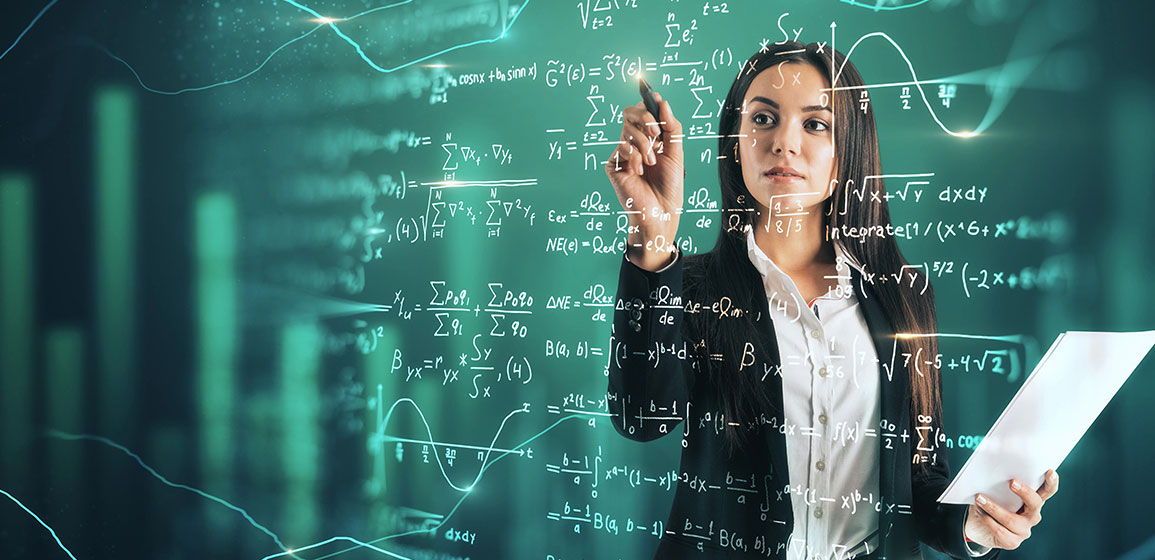
- Every AI model, from regression to neural networks, is fundamentally expressed in mathematical terms.
- Mathematical equations define how models process input data and optimize performance.
2.Bridging Theory and Implementation

- Math helps translate theoretical ideas into algorithms that computers can execute.
- Understanding gradients, optimization, and probability enables effective use of ML frameworks like TensorFlow and PyTorch.
3.Improved Interpretability and Debugging
- Mathematical literacy helps identify why a model behaves a certain way.
- Mathematical literacy helps identify why a model behaves a certain way.

4.Optimization and Model Learning

- Calculus and optimization theory describe how algorithms minimize loss functions to “learn” from data.
- Techniques such as gradient descent, momentum, and adaptive optimizers originate from mathematical concepts.
5.Statistical Rigor and Model Validation
- Statistics ensures that AI/ML models are not only accurate but also reliable and generalizable.
- It provides tools for hypothesis testing, confidence intervals, and performance evaluation.

6.The Foundation of Deep Learning

- Neural networks rely heavily on matrix operations (linear algebra) and gradient calculations (calculus).
- Understanding these principles clarifies how layers, activations, and backpropagation work.
Why Mathematics & Statistics Matter
Importance and Usefulness
Deep Understanding:
Enables practitioners to move beyond using libraries to truly understanding models.
Better Model Selection:
Choose algorithms that fit data properties and problem constraints.
Effective Debugging:
Identify learning issues through gradient flow and optimization analysis.
Innovation and Research:
Design new models or architectures grounded in solid math.
Optimization Mastery:
Tune parameters and learning rates with mathematical reasoning.
Rigorous Evaluation:
Assess models statistically rather than relying solely on accuracy metrics.
Enhanced Communication:
Explain AI systems clearly to technical and non-technical stakeholders.